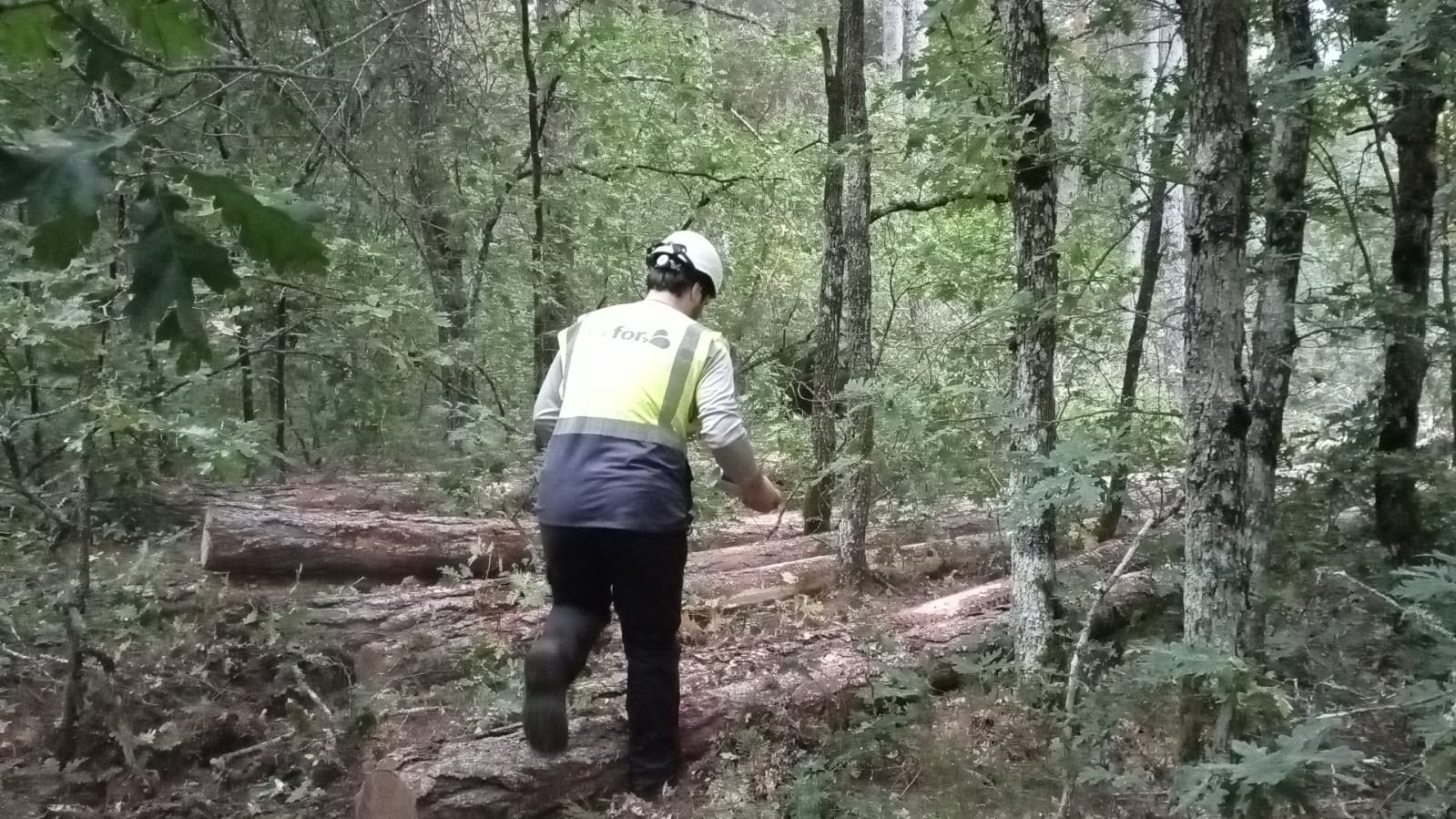
The harvesting operation in Living Lab South was carried out in September 2025. During the operation, full tree-level traceability was implemented, allowing each tree and each resulting log to be uniquely identified. This ensures that every board produced later at the sawmill can be traced back to its original tree in the forest.
Traceability Workflow: SingleTree Living Lab South
From the moment a tree is selected in the forest to the instant its wood is transformed at the sawmill, traceability lies at the core of the SingleTree Living Lab South. The goal is simple but ambitious: to ensure that every log and every board can always be linked back to its original tree, preserving both physical and digital information along the entire value chain.
The process begins in the forest, during the planning and preparation phase of the harvesting operation. A total of 50 standing trees were carefully selected across five sampling plots. Each tree was physically marked using standard forestry markings and assigned a unique traceability number, which would accompany it throughout the project. This identification was not arbitrary: the selection followed a structured sampling design, with trees chosen from each plot to ensure representativeness. At this stage, the digital identity of each tree was already established through terrestrial LiDAR scanning in each plot, providing detailed baseline data on tree structure before any intervention took place.
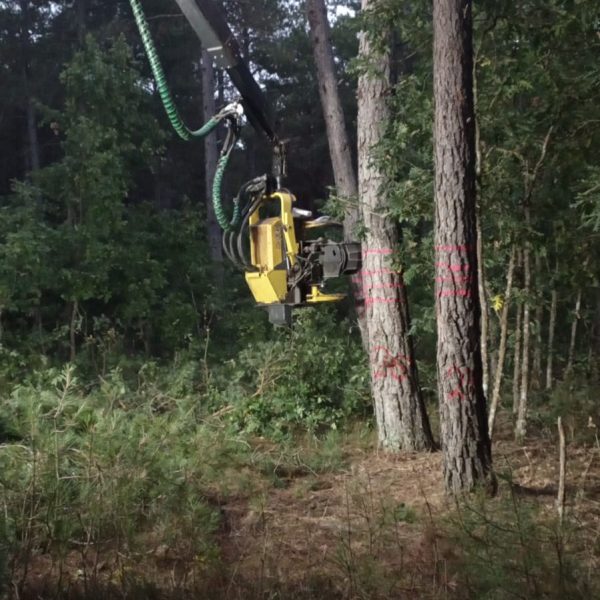
Figure: Planning and preparation phase.
Then, harvesting and log labelling took place, when the selected trees were felled and processed in the field. As each tree was cut, its identity was transferred from the standing stem to the resulting logs. Depending on the tree, one or more stem sections were produced, and each log was individually labelled using durable plastic tags applied with a forestry hammer. When multiple logs originated from the same tree, a decimal notation system was used—for example, 14.1 and 14.2—ensuring that the relationship between tree and log remained explicit and unambiguous. In the field, logs of 6 metres were produced, laying the foundation for continued traceability during later processing stages.
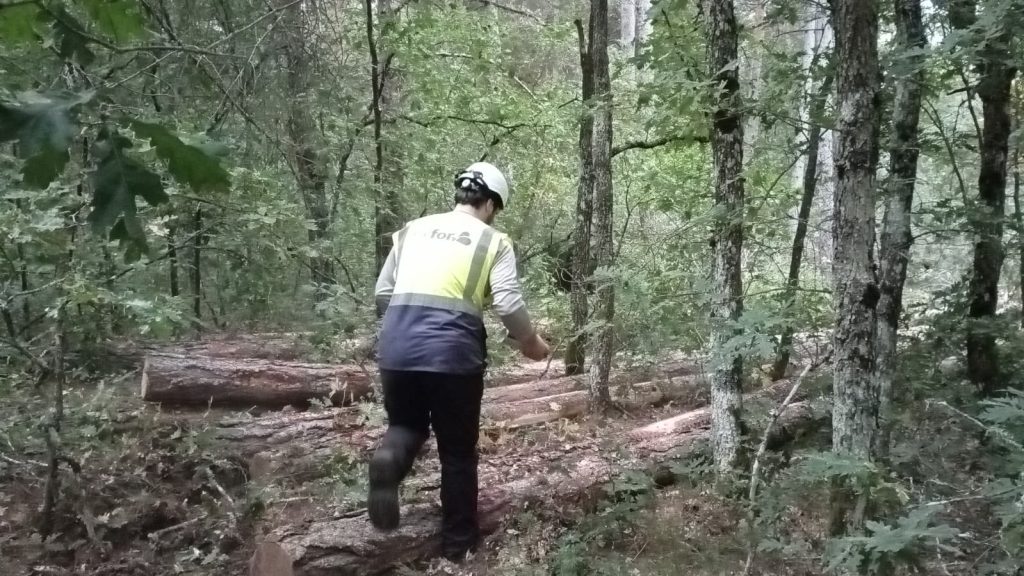
Figure: Harvesting and log labelling phase.
Once harvesting was complete, the focus shifted from the forest to extraction and logistics. The logs, distributed across the five sampling plots, were extracted and transported to the industrial partner Maderas Juez, located in Cervera de Pisuerga. Here, the traceability chain continues. Before sawing, the logs will be cut down to 2.60 metres, while carefully maintaining their identification codes. These shorter sections will then be scanned using GEOSLAM terrestrial LiDAR, capturing high-resolution geometric data that complements the information already collected in the forest. For the moment, work on these tasks continues.
Through this carefully orchestrated sequence of actions, SingleTree Living Lab South transforms traceability from a concept into a working reality, demonstrating how digital tools and field operations can be seamlessly connected, tree by tree, from forest to sawmill.
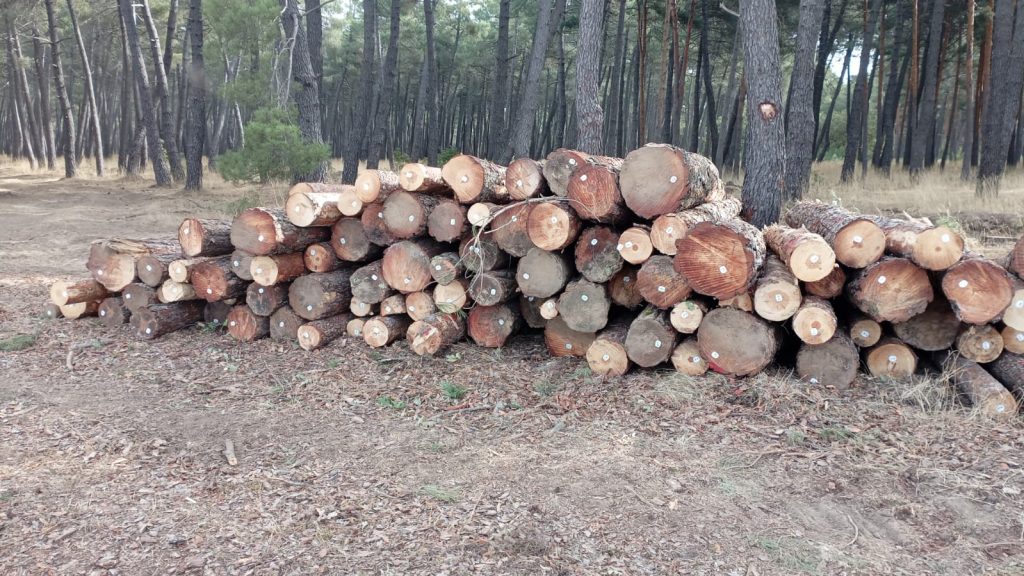
Figure: Extraction and logistics phase.
Future Sawing and Wood Sampling
The objective of the future sawing phase is to obtain a total of 150 boards for sampling. The planned strategy is to extract two boards from the basal log of each tree: one representing juvenile wood from the inner part of the stem, and another representing mature wood from the outer section. In addition, where feasible, one board will be obtained from the upper log at approximately 6.5 metres height, representing mature wood from the upper stem.
All selected boards will have a fixed length of 2,600 mm, with an approximate cross-section of 85 × 35 mm. While the length is fixed, board thickness may be adjusted depending on processing constraints and sampling needs.
As boards are produced at the sawmill, each one will be systematically numbered according to its corresponding tree, log, and stem section (for example, 14.2A, indicating tree 14, log 2, mature wood). This numbering system allows each board to be linked not only to its original tree but also to the species and the LiDAR-derived attributes obtained during earlier processing stages.
Non-destructive measurements of the wood will be carried out using the Brookhuis MTG system. Following measurement, the boards will be stacked with appropriate spacing to allow controlled air drying, prior to subsequent destructive testing in laboratory conditions.