Estimating the age of a tree has long required invasive and labor-intensive methods such as dendrochronological coring. Despite decades of forestry research, determining tree age accurately and at scale remains one of the field’s most difficult challenges.
A new study published within the SingleTree project proposes a different approach: using artificial intelligence and 3D laser scanning to estimate the age of trees directly from their structure — without cutting or coring them.
The paper, FOR-age: Benchmarking individual tree age estimation using 3D deep learning on dense laser scanning data, introduces what researchers describe as a new 3D computer vision task for forestry.
“The paper addresses a challenging question: how old is a tree? It does so by relying exclusively on the 3D structure of the tree crown,” says Stefano Puliti, lead author of the study. “Using state-of-the-art 3D deep learning models, we successfully predict tree age from LiDAR data acquired either from airborne or terrestrial platforms.”
From tree structure to age prediction
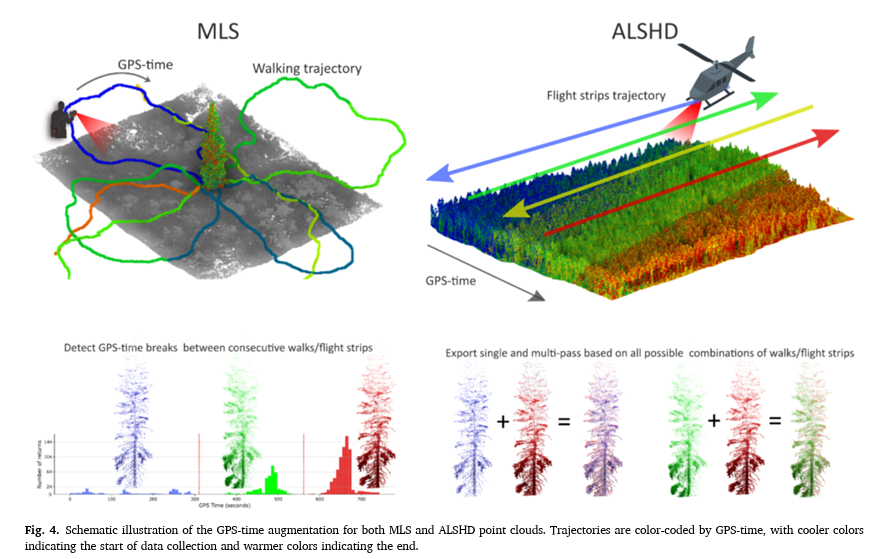
The research combines dense LiDAR data, laboratory-based age measurements, and advanced 3D deep learning architectures to estimate tree age from point clouds representing the geometry of individual trees.
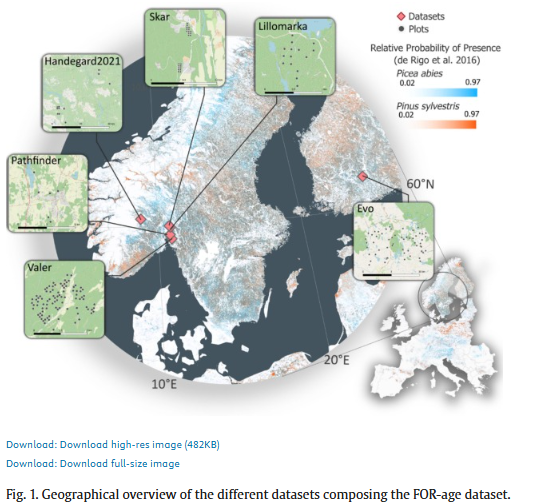
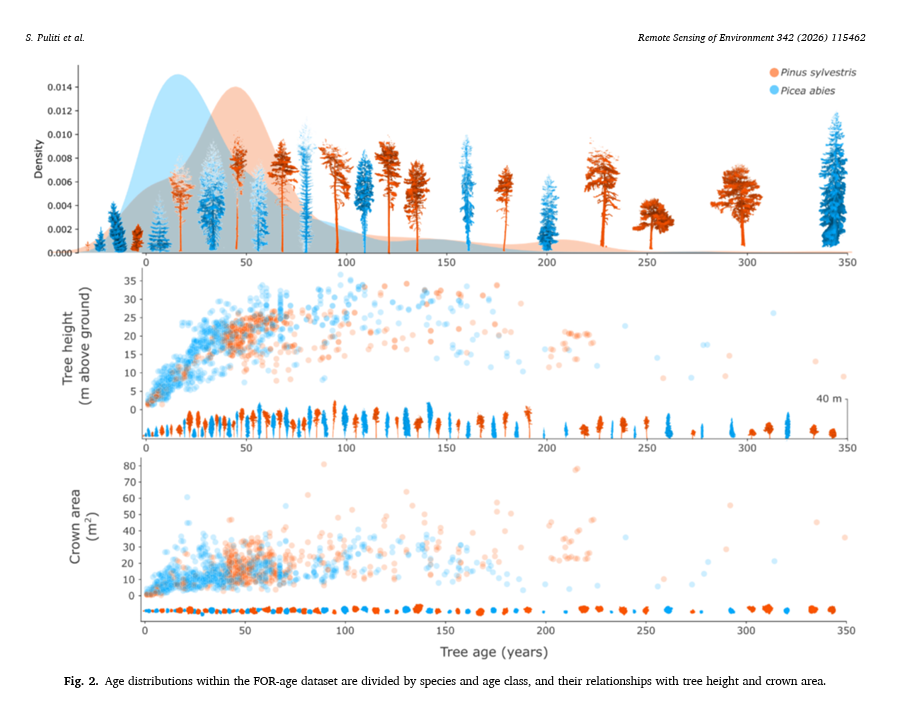
The dataset includes around 1,700 tree point clouds from approximately 1,000 trees across Norway, Sweden, and Finland. The study focuses on Norway spruce (Picea abies) and Scots pine (Pinus sylvestris), covering trees from 1-year-old seedlings to specimens approximately 350 years old.
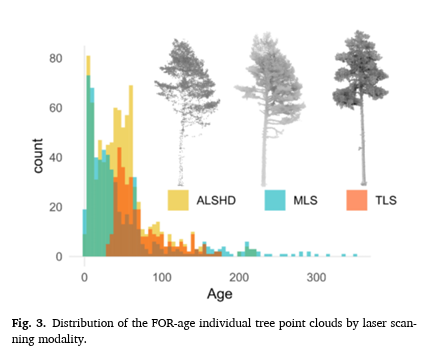
Researchers used multiple acquisition systems, including:
- Terrestrial Laser Scanning (TLS)
- Mobile Laser Scanning (MLS)
- High-density Airborne Laser Scanning (ALS)
This multi-platform approach enabled the development of models capable of generalizing across different sensing technologies and point cloud densities.
Deep learning models outperform traditional approaches
The study evaluated several modelling strategies, ranging from linear regression methods to transformer-based neural networks for 3D point cloud analysis.
Among the best-performing approaches were PointTransformerV3 and fine-tuned versions of ForestFormer3D, originally developed for tree segmentation tasks.
The researchers achieved age estimation errors of RMSE ≤ 23 years — a promising result given the biological variability of tree growth and the complexity of inferring age from external structure alone.
According to the authors, one of the most important findings was that pre-trained segmentation models already contain valuable structural information about trees.
The study also showed that:
- Joint-species training improved model generalization
- Models successfully transferred across terrestrial and airborne LiDAR data
- Robust performance could be maintained even with lower point density data
These findings are particularly relevant for operational forestry, where lower-density airborne data are often significantly cheaper to acquire.
Beyond the scientific contribution itself, the FOR-Age study also introduces an open benchmark for tree age estimation from 3D point clouds.
In line with open science principles, the project publicly releases anew annotated dataset, open-source code, and benchmarking platform for future model evaluation.
“In the spirit of open science, the paper also releases a new dataset (https://zenodo.org/records/
Authors
Stefano Puliti, Binbin Xiang, Maciej Wielgosz, Eivind Handegard, Nicolas Cattaneo, Marta Vergarechea, Terje Gobakken, Juha Hyyppä, Erik Næsset, Mikko Vastaranta, Tuomas Yrttimaa, and Rasmus Astrup.
Read the full paper here.